

AI FinOps: The Governance Conversation Every Board Is About to Have

Who approved this bill?
Not the CIO. Not the CFO. Nobody. Yet.
That is the uncomfortable truth sitting in every enterprise AI strategy right now. For years, AI cost lived quietly inside the IT budget. A line item. A subscription. Something to reconcile at the end of the month.
That era is over. AI spend isn't an IT line item anymore. It's a governance issue. And it's heading straight for the boardroom.
THE BILL STOPPED EXPLAINING ITSELF
Here's what changed. One request used to mean one model call. In the agentic era, a single task can set off a whole chain. An agent retrieves documents, queries an internal API, asks a model to organize the data, checks the answer, and tries again when something is missing.
To the user, that was one interaction. To the business, it was a dozen events. Each one has its own cost.
Multiply that across business units, providers and models, and the monthly invoice stops answering the questions a board actually cares about:
- Who consumed it?
- For what purpose?
- At what cost?
- With what outcome?
Headcount is no longer a reliable proxy for spend. Neither is the number of users. Two tasks that look identical can cost wildly different amounts. Bain found that token costs halved in a single year, yet token consumption grew 4.5 times. Cheaper intelligence isn't producing smaller bills. It's producing bigger ones.
THE HEADLINES ARE ALREADY HERE
This isn't theoretical. Look at what has been reported this year:
- UBER exhausted its annual AI budget by April 2026 and began capping AI coding tools at $1,500 per employee, per tool, per month.
- Amazon spent $1.8 million on a routine product matching project. It ran 860% over budget, and the overrun took five months to surface.
- Walmart moved its internal AI agent from unlimited use to token quotas per employee after demand spiked.
- Microsoft tightened oversight of internal AI consumption after reports that one employee used $28,000 in tokens in 28 days.
These are some of the most sophisticated technology organizations on the planet. The lesson isn't that AI is failing. It's that adoption without architecture becomes a costly governance nightmare.
WHY THIS BELONGS ON THE BOARD AGENDA
Gartner predicts more than 40% of agentic AI projects will be canceled by the end of 2027, and cost without accountability is one of the reasons why. Boards don't need to read token reports. They need confidence that three things are true:
1. Accountability. Every dollar of AI consumption has an owner.
2. Early signal. A deviation shows up in days, not five months later.
3. Value. Spend is tied to a useful outcome, not to activity.
That third one is where I'd push hardest. Counting generated responses, suggested lines of code or started conversations shows activity. It doesn't show value. The metric that matters is accepted outcomes per dollar.

Sometimes the configuration with the smaller bill is actually the more expensive one, because it delivers fewer accepted results.
That's what AI FinOps is for. It's not about spending less. It's about choosing where to spend, catching waste early, and keeping a sane relationship between cost, quality, risk and business result.
Which brings me back to the principle I keep repeating:
Governance must be step 0 in every AI strategy. Nonnegotiable. Before anything scales.
WE LIVED THIS FIRSTHAND
At Sensedia, we expanded AI coding assistance across our engineering teams, and usage took off fast. As teams moved to larger models for complex work, consumption reached 4 billion tokens a day, with peaks of up to 5 billion, across roughly 220 active developers.
Every one of those tokens runs through our own AI Gateway. Authentication, telemetry, security policies and token controls all sit in one governed layer. As our Head of AI Solutions, Filipe Torqueto, put it: "It would be extremely challenging to govern AI without an AI Gateway. All the authentication, telemetry, and security policies involving the use of OpenCode go through Sensedia's solution."
The takeaway isn't that consumption should stay small. It's that consumption should be visible, owned and governed. Growth you can see is growth you can manage.
THE ARCHITECTURE BEHIND THE CONVERSATION
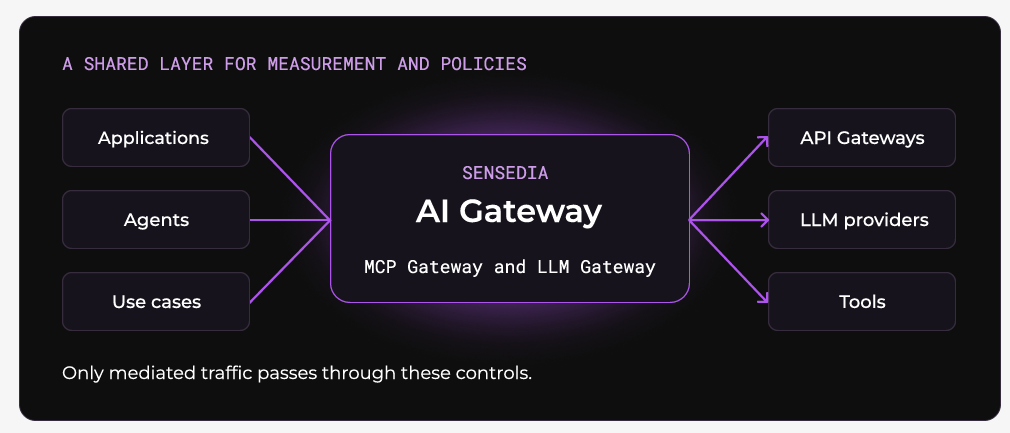
Board level accountability needs an operational layer underneath it. An AI Gateway sits between the teams consuming AI and the providers serving it. It's the natural place to set token limits per agent, turn tokens into real currency at the rates you negotiated, compare cost across providers without lock in, and export usage data to the FinOps tools you already run.
THREE QUESTIONS FOR YOUR NEXT LEADERSHIP MEETING
- What changed in our AI consumption?
- Why did it change?
- What effect did it have on the outcome?
If your team can't answer those, you don't have a budget problem. You have a visibility problem. And that one is solvable.
We put the full framework into our new whitepaper, AI FinOps: How to Scale AI Without Losing Control of Costs. It covers where AI costs really come from, how to measure ROI by useful outcome, and a practical path to get started.

Begin your API journey with Sensedia
Hop on our kombi bus and let us guide you on an exciting journey to unleash the full power of APIs and modern integrations.
Related content
Check out the content produced by our team.
Embrace an architecture that is agile, scalable, and integrated
Accelerate the delivery of your digital initiatives through less complex and more efficient APIs, microservices, and Integrations that drive your business forward.


