

AI Gateway
Govern & Scale Agentic AI with an Enterprise AI Gateway
Secure data sovereignty, govern agent access, and control token costs with the independent backbone enterprises trust. Working as both an LLM gateway and an MCP gateway, it securely orchestrates AI traffic across a "multi-everything" architecture (multi-LLM, multi-MCP, and multi-gateway). Scale safely and avoid single-vendor lock-in, all without disrupting your existing multi-vendor API ecosystem.


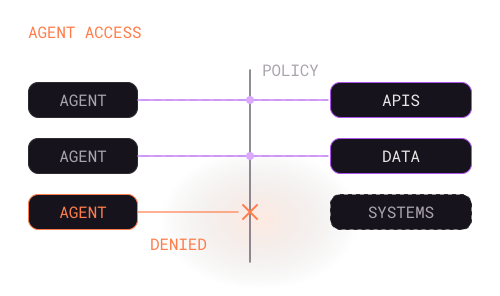
Minimize Shadow AI and Agentic Disruption
Use Sensedia as your independent backbone to control how autonomous agents interact with enterprise data. Enforce Zero-Trust policies and data sovereignty to prevent unauthorized actions and prompt-injection breaches caused by ungoverned "Shadow AI".

Orchestrate AI Traffic with a "Multi-Everything" Architecture
Dynamically route requests and switch providers with zero downtime across a "multi-everything" ecosystem—multi-LLM, multi-MCP, and multi-gateway—preventing painful "rip-and-replace" lock-in.

Gain First-Party Observability to Control AI Spend
Stop misbehaving agents before they cause unpredictable token-cost blowouts. Track deterministic and agentic traffic natively in a single pane of glass using first-party observability.

Simplifying integrations to focus on client innovation
Real-life success stories demonstrating the practical application of our solutions.






Prevent Agentic AI from Failing Before It Scales
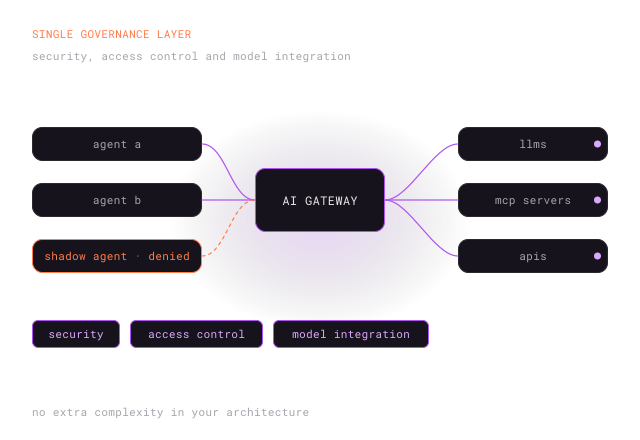
Transform fragmented AI adoption (Shadow AI) into centralized agent control. Ultimate governance to centralize, secure, and control agent behavior and model integration without increasing architectural complexity.
Embrace a "Multi-Everything" Architecture
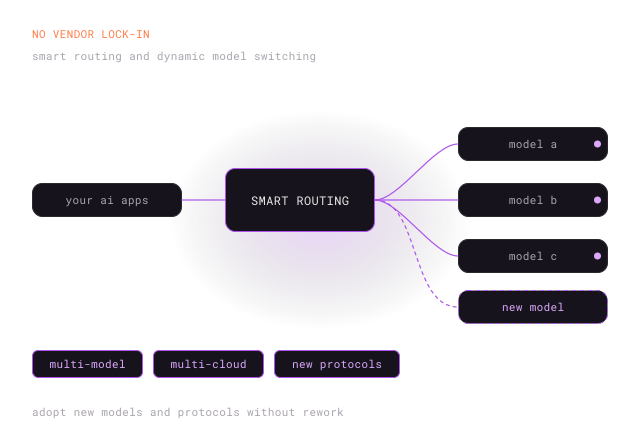
Enable architectural agility with dynamic routing and permanent decoupling Betting on a single AI vendor's governance is a trap. Flex your AI stack by permanently decoupling your control plane from the execution runtime.
Gain First-Party Observability to Control AI Spend
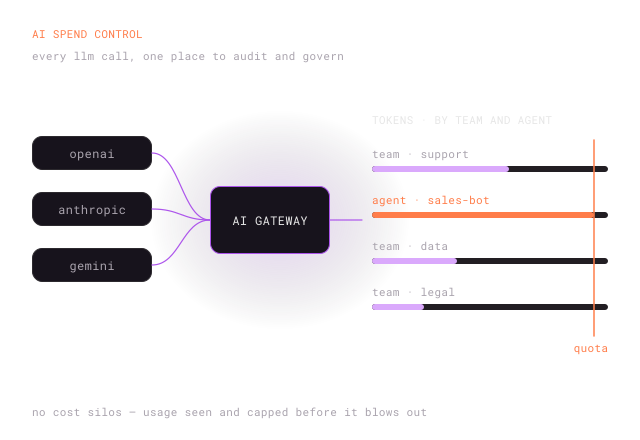
Stop token-cost blowouts with a single pane of glass. Maximize your ROI and eliminate cost silos with an independent, unified command center to audit, optimize, and govern LLM consumption across your entire enterprise.
Harness the Power of Agentic AI with an Independent Backbone
Because agentic AI will fail in production before it scales if it isn't governed from day one, enterprises must implement clear guardrails early. Innovate faster, ensure strict data sovereignty, and control agent access by governing token costs through an independent backbone. This single, transparent control plane permanently decouples from your runtime to securely orchestrate a "multi-everything" architecture (multi-LLM, multi-MCP, multi-gateway).
Discover our entire suite of products


Adaptive Governance
Ensure the security and flexibility of your architecture with confidence.


Frequently asked questions
Find here the answers to the most common questions about Sensedia’s AI Gateway
An AI Gateway is a dedicated mediation and governance layer for traffic between applications, agents, and AI models (LLMs), tools, and MCP Servers. Positioned in front of the models, it consistently applies security policies, consumption control, and observability, regardless of the provider. Just as the API Gateway organized access to APIs, the AI Gateway transforms scattered AI initiatives—related to models and tools (MCP)—into a centralized, auditable, and measurable capability.
As AI use cases and agents reach production, usage becomes fragmented: each team integrates models their own way, token costs grow unchecked, sensitive data flows through prompts, and there is no traceability. The AI Gateway mediates all this traffic in a single, agnostic layer, with security, consumption limits, and observability. Without it, the scale of AI silently amplifies risk and excessive spending.
AI governance starts with controlling traffic: knowing which applications and agents consume which models, with what data, and at what cost. In practice, this means a mediation layer that enforces access policies integrated with the corporate IdP, protects sensitive data, limits consumption per route, and generates an observable, auditable trail. This way, teams move forward with autonomy within guardrails, and the company sustains compliance requirements without becoming a bottleneck.
MCP (Model Context Protocol) connects agents to tools and data. Every MCP Server without governance is a new point of risk. With an AI Gateway, you gain agility and ease to transform your existing API ecosystem into governed MCP Servers, apply authentication and authorization (passing the user's token end to end via OAuth), control token rate limits and spending budgets, and monitor in detail all requests to tools. Third-party or internal MCP Servers can also be connected through an MCP proxy governed under the same Gateway layer.
Without governance, token consumption grows without a ceiling and without proper attribution. The AI Gateway allows you to limit consumption for each model route (TPM/RPM) and convert tokens into financial cost (based on market prices or the real rates negotiated by the company), with cost dashboards per provider, model, and consuming agent. This gives the FinOps team visibility and predictability over AI spending, forming the basis for consumption policies and chargeback across business units.
An AI Gateway applies security by policy across all AI traffic: masking of sensitive data (PII) before the prompt reaches the model, Prompt Guard against injection and jailbreak, content moderation, virtual keys that isolate provider credentials, and granular authorization for agents, integrated with the corporate IdP (SSO/OAuth2/OIDC/SAML). Combined with observability of what goes in and out of the models, this layer reduces the risk of data leaks and misuse.
Prompt injection is the manipulation of prompts to make the model ignore instructions or expose data. An AI Gateway mitigates this risk by applying policy-based controls on the path between application and model: Prompt Guard to detect and block injection and jailbreak attempts, moderation of input and output content, and masking of sensitive data before sending to the model. All of it can be enabled per route and use case, with an observable trail of what is blocked.
The AI Gateway offers a single connection point to the leading providers on the market (OpenAI, Azure OpenAI, Anthropic, Amazon Bedrock, Google Gemini, and self-hosted models) through a single interface in the OpenAI standard. This means switching or combining models does not require changing the application: routing, failover, and load balancing across providers are under the Gateway's control. This reduces dependence on a single vendor and increases the company's negotiating power.
With an AI Gateway, the application calls a single endpoint, and the Gateway directs the agent's request to the model that will serve it. You can distribute load across models (round robin), define priority-based failover to ensure continuity, and add new providers without code maintenance. The result is the freedom to combine models by cost, capability, or use case, without lock-in, while security and observability remain uniform. Zero rework for the technical team and more time to focus on business capabilities.
The Sensedia AI Gateway is a dedicated, agnostic solution from the ground up—complementary to, yet independent of, the API Gateway. It governs AI without requiring migration costs to the Sensedia platform, federating gateways from other vendors into a single catalog, without forcing traffic concentration on proprietary infrastructure. It also uses an OpenTelemetry format for monitoring, offers a hybrid model with data sovereignty in the customer's environment, generates MCP Servers from existing APIs, and provides a single access point to multiple LLMs.
The ideal choice depends on your context, but the Sensedia AI Gateway stands out for companies taking AI use cases and agents to production that need governance without giving up freedom: model and cloud neutrality, the option to keep traffic in their own environment, security by policy, cost control, and open observability. For those already investing in APIs, it extends that governance to AI on the same plan, with specialized enablement to accelerate the journey.
It connects to the leading LLM providers (OpenAI, Azure OpenAI, Azure AI Foundry, Anthropic, Amazon Bedrock, Google Gemini, and self-hosted models), to internal and third-party MCP Servers, to corporate IdPs (OAuth2/OIDC/SAML, such as Keycloak, Okta, and Auth0), and to observability tools (Grafana, Datadog, Dynatrace) via OpenTelemetry. Within the Sensedia ecosystem, it integrates with API Management, Access Control, and Integrations, with an interface in the OpenAI Chat Completions standard.
Elevate your AI strategy with governance and control
Adopt a modular, multi-model connectivity hub that enables dynamic routing and seamless model switching with architectural agility across multiple gateways, AI models and emerging protocols.


