

Why the AI Gateway is Essential for Companies Using AI Agents

In an enterprise landscape where AI adoption has evolved from mere experimentation to becoming the core of autonomous operations, the governance of AI agents shouldn't be viewed as a brake, but rather as an indispensable strategic accelerator.
This requires technical and business leaders in large organizations to rethink how they connect, govern, and scale their integrations—mitigating risks while enabling secure innovation. In this new reality, using an AI gateway becomes increasingly essential.
What is an AI Agent?
Simply put, an AI agent consists of an LLM (Large Language Model), prompts, and tools working in a loop. Unlike traditional applications where execution follows a strict, predetermined flow, an agent translates human intent into dozens of autonomous calls and behind-the-scenes decisions, acting as a new non-deterministic "consumer" of an enterprise's APIs.
How Does an AI Agent Work?
An AI agent operates by receiving a request that enters its execution environment (the Agent Runtime). There, it uses reasoning, skills, memory, and context to determine its next steps.
To solve a problem, the agent doesn't work in isolation: it accesses LLM providers, interacts with databases, triggers sub-agents, and consumes internal or external APIs. For an agent to be genuinely useful and intelligent, it depends heavily on the context it can gather within the organization's ecosystem.
Related content: Multiple LLMs: How an AI Gateway Facilitates Their Use in Enterprises
What is an AI Gateway?
An AI gateway is a centralized control layer designed to govern AI agents at scale. Just as API gateways abstracted complexity for microservices, an AI gateway mediates and governs everything an AI-based application needs to touch to function—ranging from communicating with LLMs to accessing APIs and databases via MCP servers.
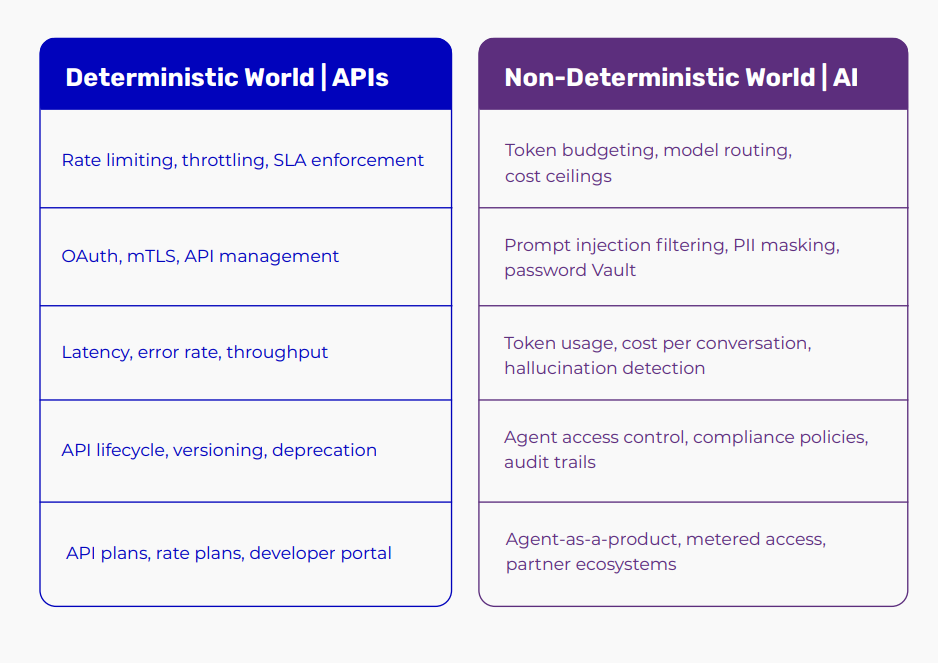
It acts as the secure bridge connecting deterministic systems (legacy systems and current APIs) with the new non-deterministic world of AI. Unsurprisingly, for organizations that already govern their APIs, an AI gateway is a natural extension of that discipline, not a disconnected layer.
What is the Role of MCP in AI Strategies?
MCP (Model Context Protocol) is a protocol that easily connects a company's tools, databases, and APIs to its AI agents, helping provide the context they need.
However, it is vital to understand that while MCP abstracts certain connectivity points, it does not resolve systemic complexity on its own. Without governance, it cannot ensure that data usage and resource reuse are carried out in a secure and controlled manner.
Related content: How MCP Makes a Difference in AI Strategies
Why is AI Governance Important for Enterprises?
The absence of governance in an agentic ecosystem can lead to system catastrophes due to the speed and autonomy with which agents operate.
A lack of control leads to Shadow AI—which happens when different squads create their own decentralized, ad-hoc integrations. This creates severe security risks and results in skyrocketing, invisible token costs. Furthermore, uncertainty around what agents are allowed to access ultimately paralyzes innovation, causing proofs of concept (PoCs) to never make it into production.
How Does an AI Gateway Contribute to AI Governance?
The tool brings order to chaos through centralization—an architectural prerequisite for governance. The AI gateway provides a "single pane of glass" for viewing, auditing, and tracking all consumption and decisions made by AI agents. It manages identity propagation, making it possible to verify that both the agent and the logged-in user have the actual permissions required to perform operations and access specific back-end contexts. The implementation encompasses visibility and financial management: establishing quotas and budgets by team, model, or agent transforms opaque token consumption into predictable, controlled investments.
How Does an AI Gateway Drive Innovation?
Far from adding bureaucracy, an AI gateway acts as an enabler. It democratizes secure access to information and models, allowing both business and tech teams to build AI agents without violating company policies.
By establishing guardrails (safety boundaries), the organization gains the confidence required to move experimental projects off the whiteboard and into production quickly and securely.
How Does an AI Gateway Ensure Security in AI Strategies?
AI security is built in layers, and an AI gateway supports a Zero Trust by design architecture. It operates on the front lines by providing critical functionalities:
- Prompt and Data Sanitization: Mitigates prompt injection attacks and prevents sensitive data leaks or PII exfiltration (Data Exfiltration).
- Containment of Rogue Agents: Enforces strict execution scopes, tool allowlists, and consumption limits (rate limiting and token budgets), containing agents that deviate from expected behavior.
- Credential Protection: Centralizes provider API keys at the gateway level so that agents never have direct access to them.
- Full Observability: Delivers comprehensive, traceable audit trails (logs, request tracing, and token cost monitoring), significantly mitigating the risk of Shadow AI.
Conclusion
The true competitive advantage in the market won't belong to companies that simply build the largest number of agents, but rather to those that first establish a solid infrastructure to scale them with total confidence, visibility, and security.
By implementing an AI gateway, organizations can bridge their existing deterministic ecosystem with the new non-deterministic world, ensuring that rule structuring is "Phase 0" of their projects. This ensures that innovation happens sustainably, protecting the organization from Shadow AI threats and turning AI's potential into real, predictable business outcomes.
Want to know how AI Gateway can bring scalability to your company's AI initiatives? Talk to our experts now!

Begin your API journey with Sensedia
Hop on our kombi bus and let us guide you on an exciting journey to unleash the full power of APIs and modern integrations.
Related content
Check out the content produced by our team.
Embrace an architecture that is agile, scalable, and integrated
Accelerate the delivery of your digital initiatives through less complex and more efficient APIs, microservices, and Integrations that drive your business forward.


.svg)