

What is the difference between an AI Gateway and an API Gateway?
.png)
APIs are essential components of the intelligent backbone of large companies, connecting systems, data, partners, and channels. They form the foundation of virtually every digital product. With the arrival of AI at scale, a new type of traffic began circulating in this ecosystem: AI applications and agents consuming models, tools, and services. This movement places two solutions at the center of the enterprise architecture debate: the AI Gateway and the API Gateway.
They are distinct tools with different purposes. They do not compete with each other; rather, they complement one another. This article explains what each one is, which companies need each solution, and how organizations can combine them to enter the agentic era with control, security, and visibility.
What is an AI Gateway, and which companies need this solution?
The AI Gateway is a layer that enables governance over a company's AI traffic, providing security, cost control, and observability. It operates between applications and model providers, governing calls to LLMs, tools, and AI agents.
Its value proposition is to address issues specific to AI traffic: uncontrolled token consumption, exposure of sensitive data in prompts, risk of prompt injection attacks, scattered usage across teams and vendors, and a lack of traceability.
Companies that need this solution are those already scaling their pilots to production and wanting an AI governance layer over this traffic. It also benefits organizations seeking to expose their APIs as MCP servers for agents, perform data masking and risk mitigation, and control the rising cost of tokens by leveraging AI FinOps practices.
Related Content: What is MCP and how to use it in your AI strategy?
What is an API Gateway, and which companies need this solution?
The API Gateway is the entry point for API calls. It receives requests and applies policies for security, authentication, routing, protocol mediation, and traffic control before forwarding them to the destination system. In practice, it is the component that ensures an API is exposed in a secure, standardized, and scalable manner.
It is part of a broader discipline—API Management—which also encompasses design, lifecycle, developer portals, analytics, and governance. The Gateway is the execution layer; API management organizes everything else.
Companies that typically need an API Gateway are those that expose APIs to partners, digital channels, or third parties and require access control and consumption visibility. Accelerating digital product launches, exposing legacy systems as modern APIs without needing to rewrite the backend, and standardizing APIs already in production are other use cases demanding this solution.
What are the main differences between an AI Gateway and an API Gateway?
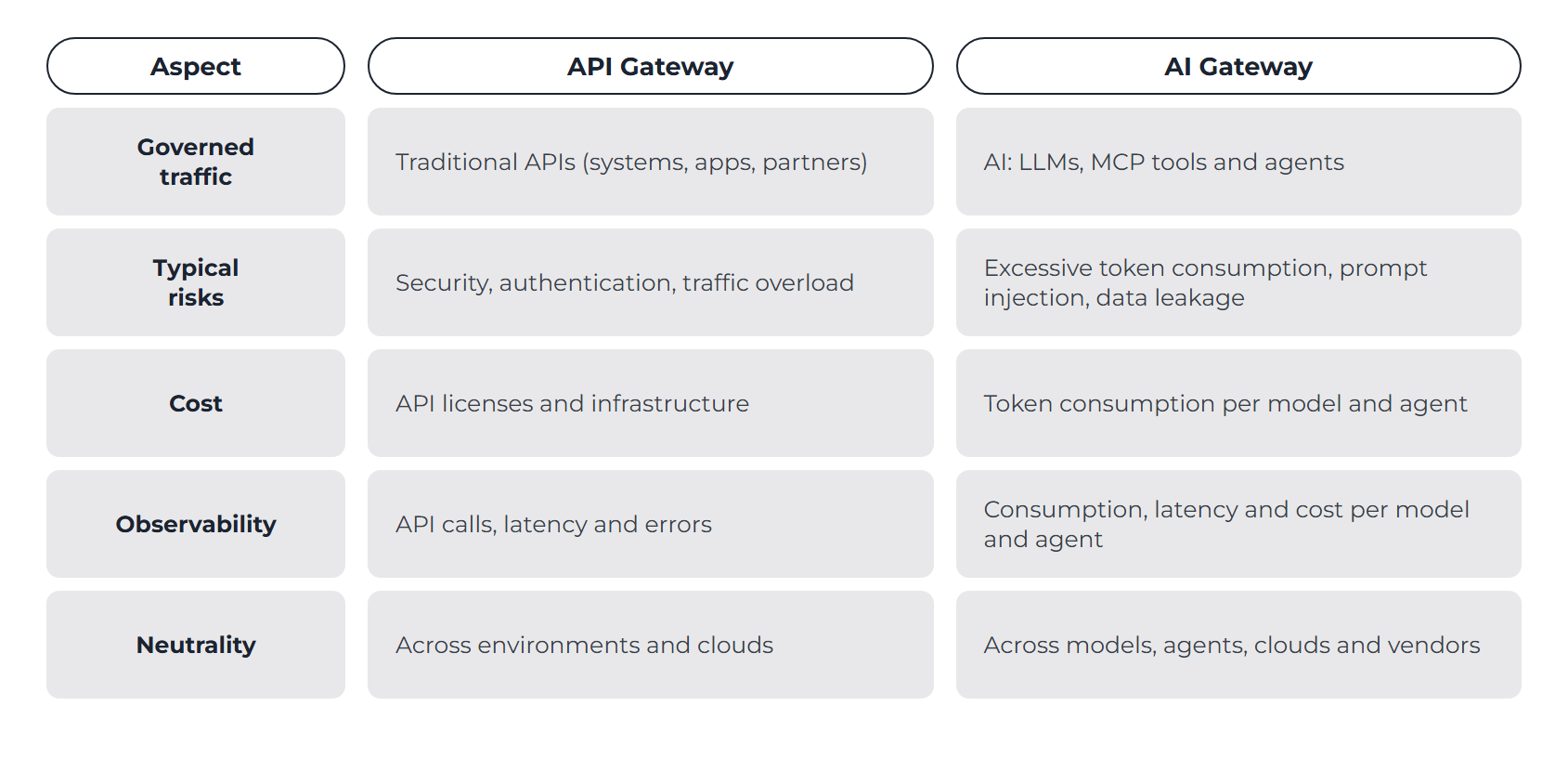
Both share principles of mediation, policies, and observability. The difference lies in the type of traffic each governs and the risks each addresses. The API Gateway handles traditional API traffic between systems, applications, and partners. The AI Gateway handles AI traffic between applications and AI agents on one side, and models, tools, and other agents on the other.
To a certain extent, the AI Gateway plays a role for AI similar to what the API Gateway plays for APIs: creating a central point of governance, security, observability, and control.
The table below summarizes the main differences:
How does well-structured API management enable AI management?
APIs are the substrate that connects enterprise systems, data, and capabilities. When a company properly structures the management of these APIs—with standardized design, defined lifecycles, identity, security policies, and observability—it creates a reliable, reusable asset.
This same substrate is what AI consumes. AI applications and agents access systems and data through APIs. If these APIs are well-governed, the AI automatically inherits identity, policies, security, and traceability. In other words, AI management originates from API management: without a healthy API ecosystem, it is difficult to govern what models access, who accesses them, and at what cost.
How to promote synergy between the AI Gateway and the API Gateway?
Synergy begins with understanding that the two are complementary. The API Gateway ensures existing APIs are governed, secure, and reliable. The AI Gateway governs how models and agents consume those capabilities. One takes care of the ecosystem; the other takes care of AI consumption on top of it.
In practice, this means operating both within the same governance plane, sharing identity, policies, and observability. APIs already governed in the API Gateway can be presented as MCP servers consumable by AI agents, and the AI Gateway then mediates this consumption with security, cost control, and visibility. The result is a smooth transition: the company leverages its prior API investments while gaining a dedicated layer for new AI traffic.
What is the importance of APIs in AI strategies?
An AI strategy that ignores APIs tends to produce solutions lacking context and disconnected from what the company actually does. AI models need real data and systems to generate value, and APIs expose these assets in a secure, controlled way.
The Model Context Protocol (MCP) reinforces this importance. It standardizes integration between models and systems, allowing existing APIs to be exposed as tools that agents can consume. An API transformed into an MCP Server ceases to be merely a service accessible by applications and becomes an actionable capability for AI agents.
However, exposing APIs as MCP Servers also expands the attack surface. Therefore, this exposure requires governance: authentication, scopes, consumption limits, discovery, observability, and auditing. Without this, every tool becomes a potentially uncontrolled access point. The AI Gateway steps in precisely to mediate and govern these tools, maintaining security for whoever consumes them.
Related Content: How to prepare your APIs for AI agents?
Why is it important to rely on agnostic API Gateway and AI Gateway solutions?
In the API world, operating across multiple clouds and environments without being locked into a single vendor's infrastructure is a major advantage. In the AI world, neutrality carries even more weight because the model ecosystem evolves rapidly.
An agnostic solution allows you to swap and combine models and providers without rewriting applications, as well as centralize and govern different types of agents from various sources in a single place. In the case of the AI Gateway, it also means governing AI where APIs already reside—even federating other gateways—without concentrating traffic in proprietary infrastructure. For large companies, this protects investment, reduces vendor lock-in risk, and preserves architectural flexibility.
Conclusion
Every enterprise aiming to enter the agentic era needs a solid API foundation and an AI governance layer. The API Gateway prepares the ecosystem, ensuring enterprise capabilities are exposed securely and in a standardized manner. The AI Gateway governs AI traffic, providing cost control, security, and visibility into what models and agents consume.
Together, they enable fast-paced innovation without losing control. This combination transforms scattered AI into a measurable, auditable, and secure enterprise capability. In a landscape where AI agents increasingly become part of daily operations, having both an API Gateway and an AI Gateway is what separates ad-hoc adoption from sustainable transformation.
Want to leverage the synergy between AI Gateway and API Gateway to generate more revenue for your business? Talk to our experts today!

Begin your API journey with Sensedia
Hop on our kombi bus and let us guide you on an exciting journey to unleash the full power of APIs and modern integrations.

Embrace an architecture that is agile, scalable, and integrated
Accelerate the delivery of your digital initiatives through less complex and more efficient APIs, microservices, and Integrations that drive your business forward.


.svg)